The rider's guide
The Get-Back Biker Whip
Everything you didn't know you needed to know about the leather braid hanging from your handlebar — history, length, colors, construction, and how to pick the right one for your bike. From a Tennessee shop that's been making them since 2004.
What is a get-back whip?
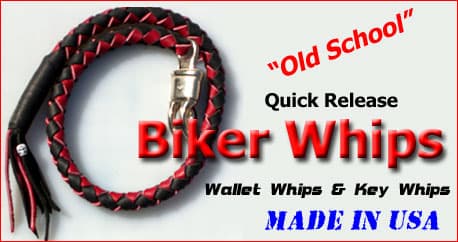
A get-back whip is a hand-braided leather strap, typically 25 to 48 inches long, that hangs from a motorcycle's handlebar via a quick-release panic snap. The name comes from outlaw motorcycle club culture of the 1950s and 60s — a rider trailing too close or riding sloppy would be told, sometimes with a swung length of leather, to get back on their side of the road.
Today the practice is gone, but the whip stayed. It's worn as tradition, as a nod to the founding generation, and — for riders who care about the details — as a rolling piece of custom leatherwork that ties into the rest of a bike's aesthetic. A well-made whip is one of the few pieces of gear on a motorcycle that's handmade, one at a time, in a workshop.
“The whip on my handlebar is the first thing my grandkids notice when I pull up. It's not a weapon, it's not a decoration — it's a story I'm carrying.”
What length should you get?
Length is a function of your bike, your bars, and how you ride. Here's the honest breakdown:
| Length | Best for | Notes |
|---|---|---|
| 25–30″ | Sportsters, mid-size cruisers, small custom builds | Tucks in cleanly with drag bars or low bars. Doesn't drop into the fork area. |
| 31–36″ | Most Harleys, Indians, mid-frame metric cruisers | The sweet spot. Long enough to move visibly, short enough to stay clear of moving parts. |
| 37–42″ | Baggers, tourers, ape-hanger bar setups | Popular on Electra Glides and Road Kings. Hangs proud without dragging. |
| 43–48″ | Choppers, long-fork custom builds, tall ape hangers | For riders who want the whip to be the focal point. Check ground clearance with your bike parked. |
When in doubt, go shorter. A whip that's too long is a real safety issue — it can catch the front wheel, snag on a fork, or wrap into the primary. Too short is only a style compromise.
The 33-color palette
Every Chilhowee whip is built with your choice of up to four colors, drawn from a palette of 33 dyed leathers we keep in the shop. The first color you pick is the wrap at the bottom of the whip; colors two through four form the braided body.
Popular combinations riders come back for:
- Black & Red — classic outlaw combo, works on almost any bike
- Black & Chrome / Shiny Silver — modern, matches any bike with chrome trim
- Black & Canary Yellow — high-visibility for day riders
- Black · White · Red — a nod to old Harley factory livery
- Four-color rainbow builds — combine any four; we'll make it work
All 33 shades, front and reverse-face samples where both are available. What screens show and what leather is are two different things — this is the real reference.
Hand-braided vs. machine-made
Search Amazon for a get-back whip and you'll see prices from $20 up to $50. Most of what shows up in that range is machine-braided leather (or often bonded leather — ground scrap pressed together with polyurethane), imported by the container and drop-shipped with a swappable brand label. It rides fine. It doesn't age well.
A hand-braided whip made from full-grain dyed leather has three things a machine can't replicate:
- Consistent tension. A hand-braider pulls each strand with the same feel every strand. A machine over-tightens the outside strands and under-tightens the inside ones — that's why cheap whips develop wavy edges within a year.
- Real leather grain. We cut our strips from full-grain dyed sides. The color goes through, not just onto, the leather. Chips and scuffs blend in instead of showing the raw fiber underneath.
- Proper hardware. Every one of our whips uses a genuine panic snap — the two-slider quick-release. Many cheap whips use a bolt snap that looks similar but doesn't release under load. That matters more than any other single component. (See the next section.)
The panic snap: your hidden safety feature
The panic snap is the metal clip at the top of the whip where it attaches to your clutch or brake lever. It has two spring-loaded sliders on either side. Squeeze both, and the snap releases instantly — the whip drops away from your bike, and you're free of whatever it caught on.
It has to be a panic snap, not a plain bolt snap or trigger snap. Those look similar but don't release under tension — meaning if the whip catches on something at speed, the bike gets pulled with it. Every Chilhowee whip ships with a proper industrial-grade panic snap in either polished silver, gunmetal, or antique brass to match your bike's finish.
If you bought a get-back whip somewhere else, check the hardware before your next ride. Grip the snap in your fist and squeeze — if you can't open it with pressure from a gloved hand, it's not a real panic snap. Replace it.
How to install and use your whip
Installation takes 15 seconds. Squeeze the panic snap open and clip it around your clutch lever (traditional) or brake lever. The snap should sit at the base of the lever, not the tip — that way it can't interfere with the lever's throw.
- Traditional mount: clutch (left) side, so your throttle hand stays clear
- Symmetrical: one on each side, matched or contrasting
- Both on the clutch side: layered pair for a fuller look — common on customs
Before your first real ride, walk the bike back and forth in your driveway with the whip installed. Check that the fall of the whip clears your fork, front tire, and any forward controls or highway pegs at full-lock steering. If it drags on anything, go shorter or move the mount higher on the lever.
Care & maintenance
Leather that gets wet, dried in the sun, and wet again — which is what a whip lives through every riding season — needs periodic conditioning to stay supple. Neglected whips get stiff, crack at the flex points, and lose color.
The short version:
- Wipe down with a dry cloth after every wet ride — don't let water soak in overnight
- Condition with a leather cream (we like Chilhowee Buffalo Butter — designed for exactly this) two or three times a season
- Long-term storage: hang the whip loose (never coiled tight) in a dry, dark spot — UV fades color faster than anything
- If it gets salty from winter riding, wipe with a barely-damp cloth first, then condition
Full leather-care walkthroughs live on our care guide page. They apply to every piece of leather on your bike, not just the whip.
Frequently asked questions
What does “get back” mean?
It’s biker shorthand for “get back on your side of the road.” In outlaw motorcycle club history, a rider trailing behind or riding aggressively would be sent a warning — sometimes with a swung leather whip — to get back where they belonged. The name stuck long after the practice faded; today it’s worn as tradition and a rolling piece of the culture.
Are get-back whips legal?
In almost every US state, yes. A leather braid attached to a handlebar isn’t a regulated weapon under any federal law and most state weapons statutes. A very small number of jurisdictions have vague “dangerous instrument” language that a prosecutor could stretch, but arrests specifically for a get-back whip are exceedingly rare. Check your local vehicle-code and weapons statutes if you’re in doubt — we’re not attorneys.
How long should my whip be?
For most cruisers, 30–36 inches is the sweet spot — hangs cleanly from the handlebar without dragging near the front tire. Baggers and tourers with taller bars often go 36–42 inches. Choppers and long-fork custom builds can carry 42–48 inches without looking oversized. If you’re between sizes, go shorter — a whip that’s too long is a real safety issue near moving parts.
What’s the panic snap for?
The panic snap is a two-slider quick-release hardware piece where the whip attaches to your clutch or brake lever. If the whip ever catches on something — a passing branch, another rider’s bike — you can release it with a squeeze from either hand, even at speed. This is non-negotiable safety hardware on every whip we build. Never use a plain bolt snap.
Can I get colors that aren’t on the chart?
The 33 colors on our chart are the leather shades we stock and can guarantee color-match on. Custom dye lots are possible for larger commercial orders (contact us for details), but for one or two whips we’ll steer you to the closest palette match — leather takes dye differently than fabric, and matching an off-chart color to a bike paint code isn’t a service we can honor without testing first.
How long does a Chilhowee whip take to build?
Stock in-shop configurations ship within 2 business days. Custom color-and-length combos ship in 2–5 business days depending on our production queue — shorter than most competitors because every whip is braided in-house in Tennessee, not shipped in from overseas and repackaged.
Do I need a whip on both handlebars?
One is traditional — usually mounted on the clutch (left) side so your throttle hand stays free. Some riders run one on each side for symmetry. A few carry a set of matched short whips as a rolling color statement. There’s no right answer; it’s your bike.
Ready to build yours?
Configure your Get-Back Whip
Pick your length (25″–48″), pick up to four colors from the full palette, and we'll braid it in-shop in Tennessee. Ships in 2 business days.
Questions? customercare@chilhoweemotorcycleleather.com